
India’s corporate sustainability chat is getting more data-driven. Everything from carbon emissions to energy efficiency to industrial wastewater is becoming something that companies are expected to understand and report.
But there is one common area that needs more attention in this discussion: water use in corporate bathrooms. Office buildings, manufacturing facilities, IT parks, educational institutions, hospitals and commercial complexes rely on restrooms on a daily basis.
Large facilities can waste a lot of water because of old flush systems, fixtures that leak, or inefficient lavatory infrastructure. It’s a big opportunity for companies to prepare their Business Responsibility and Sustainability Report (BRSR).
Water is already part of environmental disclosures but internal monitoring might still miss water use at the lavatory level. The problem is not so much the absence of regulatory requirement. It’s a possible disconnect between reporting total water numbers and knowing where that water is being used.
BRSR: What is it and Why is it important for Indian Companies?
In May 2021, the Securities and Exchange Board of India (SEBI) introduced the Business Responsibility and Sustainability Report (BRSR) framework to improve ESG disclosures among listed companies.
BRSR wants companies to report on their performance across nine principles of the National Guidelines on Responsible Business Conduct. Principle 6: Environmental responsibility, such as water management.
The framework includes disclosures about:
- Water withdrawal by source
- Overall water consumption.
- Water discharged and treated.
- Water intensity per sale.
- Water-related information – Facilities in areas of water stress.
Water withdrawal, consumption and discharge were also indicators requiring phased assessment in SEBI’s BRSR Core framework issued in July 2023.
That makes water management an important consideration for firms that want to ramp up their environmental reporting. Reporting total water use, however, is only one aspect of responsible water management. Equally important is knowing where the consumption comes from.
The Other Water Use Point: Corporate Bathrooms
When companies talk about water conservation, their thoughts tend to go toward industrial processes, cooling towers, landscaping and wastewater treatment plants.
Rest rooms may be of relatively less interest. Commercial buildings have steady loo traffic all day long at work. The conventional flush toilet and urinal depend on water to function, and in a high occupancy facility the aggregate demand can be large.
Imagine an office block where hundreds or thousands of people come through every day. Hand washing, toilet flushing, urinal flushing, general cleaning; water. Small inefficiencies can add up when fixtures are used repeatedly throughout the year.
A 2024 research paper in Water Research X looked at water savings in commercial and institutional buildings from urine-diversion systems. The results pointed out the possible interest of these systems in places like offices, hospitals, educational centers and airports.
The conclusion is simple: lavatory infrastructure should be included in corporate water-efficiency conversations.
Why Lavatory Water Use Needs Better ESG Monitoring?
A company’s total water use is a measure of its environmental footprint but doesn’t always show which activities are responsible for the most water use.
For example, a company may know how much water its manufacturing processes use, but have little idea about its lavatory fixtures.
This leaves several opportunities for improvement.
- See which fixtures use a lot of water
Facility managers can check the types of toilets, urinals, taps and flushing systems used throughout their buildings.
- Check the amount of water used regularly
Water meters, sub-metering and fixture level assessments can help to identify unusual consumption patterns, leaks and potential inefficiencies.
- Evaluate current infrastructure
Older flush may offer opportunities for improvement with efficient fixtures or alternative technologies.
- Take restrooms into account in sustainability planning
Restroom water management is not just an operations or housekeeping responsibility; it can be part of a larger corporate water-efficiency strategy.
These steps can help companies to understand their water-use patterns and identify practical conservation opportunities.
Waterless Urinals: A Business Opportunity in Water Conservation
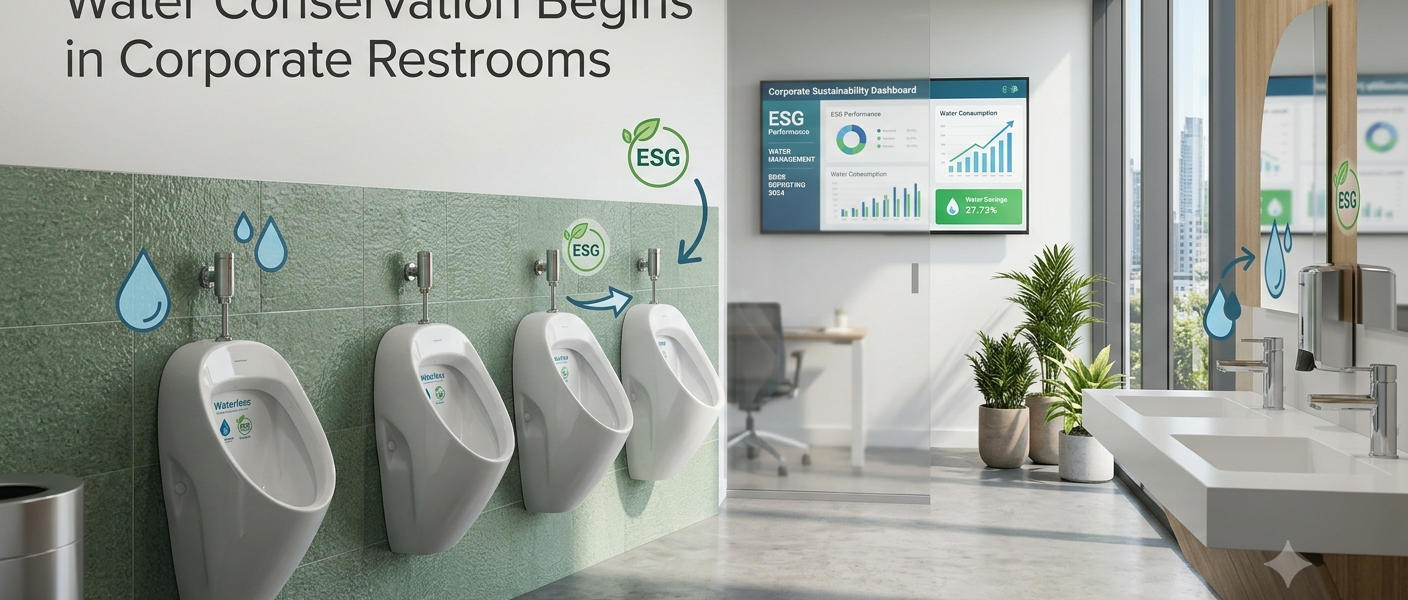
One technology to consider is the waterless urinal. Standard urinals have water flushed after usage. Waterless urinals are designed to function without flush water, thus reducing the water demand associated with conventional urinal flushing.
Depending on the technology, these systems incorporate specially designed traps, cartridges or sealing mechanisms to control the flow of urine and to help with odour control.
Waterless urinals are also mentioned in the Indian government’s guidelines for healthcare facilities as a way to reduce water consumption in institutional buildings.
In corporate offices, factories, airports, schools and other high-occupancy facilities, the technology can be seen as part of an overall lavatory sustainability strategy.
However, the implementation needs to consider:
- Compatibility with existing plumbing systems;
- Proper installation and commissioning.
- Routine maintenance as suggested by the manufacturer.
- Proper cleaning methods.
- Availability of replacement parts where needed.
Waterless urinals are not a substitute for all restroom water needs. You still need to manage your water for hand washing, toilet flushing and cleaning.
Their contribution is specifically about the removal of the flush-water demand at urinals.
Link Lavatory Improvements to BRSR Reporting
Companies preparing BRSR disclosures need to link better lavatory infrastructure with measurable environmental outcomes. One practical approach is to establish a baseline before any changes are introduced.
Companies can take the following steps:
| Action | ESG relevance |
| Conduct a restroom water audit | Identifies potential water-use inefficiencies |
| Record existing fixture specifications | Establishes a baseline |
| Identify high-usage facilities | Helps prioritise interventions |
| Introduce suitable water-efficient fixtures | Supports water conservation |
| Monitor changes after installation | Helps evaluate actual performance |
| Maintain supporting records | Strengthens reporting and verification |
Importantly, companies need to differentiate between estimated and measured water savings.
For instance, conventional urinals can be substituted with waterless models to decrease the demand for flushing water. Actual savings however will depend on specifications of the previous fixture, frequency of use, operating conditions and maintenance.
Rather than reporting estimated savings as independently verified results, companies should document their assumptions and calculation methodology. SEBI’s BRSR framework also focuses on providing contextual information on water-related calculations, including methodologies and assumptions.
Why ESG Teams and Facility Managers Need to Collaborate?
Water conservation must not be the sole responsibility of one department.
ESG teams are aware of reporting requirements, sustainability targets and environmental performance indicators. Facility management teams know the building’s infrastructure, its maintenance needs and its daily water usage. The teams working together help the company see areas that need improvement that may not be seen otherwise.
For example, an ESG team may target water consumption as a focus area, and facility managers can determine whether lavatory fixtures are a viable solution to reduce demand.
Procurement teams also have a role to play by factoring in water efficiency when choosing lavatory products and infrastructure for new buildings or renovation projects. This cross-functional approach can help translate sustainability commitments into measurable operational improvements.
Incorporating Restroom Sustainability into a Corporate ESG Strategy
As India increasingly turns its attention to sustainability reporting, companies have a chance to explore beyond the traditional areas to improve the environment.
Restroom water use may not always be separately visible in corporate sustainability dashboards—but it’s not irrelevant. Companies can improve their approach to water management by looking at every area where they use significant amounts of water, including the facilities that employees and visitors use every day.
Organisations looking to explore sustainable lavatory infrastructure as part of a wider water-conservation strategy can look at solutions such as Zerodor Waterless Urinal technology, offered by Ekam Eco Solutions.
The important step is to evaluate suitable technologies, measure their actual contribution and incorporate the findings to the company’s wider environmental management practices.
At the end of the day, responsible ESG reporting is not only about the environment. It is about understanding what is going on behind those numbers and how can we improve them in a practical way. One of the most overlooked opportunities for corporate water conservation may not be inside the production facility, but in the lavatory used every day.