COP31 and India’s Buildings: Why Commercial Water Use Needs to Be the Next Agenda Item?

As climate discussions move from ambitious commitments towards practical implementation, the buildings in which people work, study, shop and receive healthcare deserve closer attention. They are not just consumers of electricity. They also depend on substantial quantities of water for everyday operations, from washrooms and kitchens to cooling systems, cleaning and wastewater management.
This connection deserves greater attention in India’s climate conversation. COP31, being held in Antalya, Türkiye, from 9 to 20 November 2026, has placed considerable emphasis on implementation, climate-resilient cities and the built environment. The conference’s priorities include reducing energy consumption intensity in the building sector by at least 25% by 2035.
Its programme has also given greater visibility to resilient cities, infrastructure and water. These are important developments. However, there is another question that deserves to sit alongside building energy efficiency: How much water do our commercial buildings consume, and how efficiently do they use it?
The overlooked water footprint of commercial buildings
When businesses discuss sustainability, energy consumption is usually among the first indicators considered. Electricity bills, air-conditioning efficiency, lighting systems and renewable energy installations have become familiar parts of building-management discussions.
Water often receives less attention. Yet commercial buildings require water every day. Offices, educational institutions, hospitals, hotels, shopping centres and industrial facilities all depend on reliable water supplies to maintain basic operations.
The demand comes from several sources:
- Washrooms, toilets and urinals.
- Kitchens, cafeterias and food-service areas.
- Floor cleaning and general housekeeping.
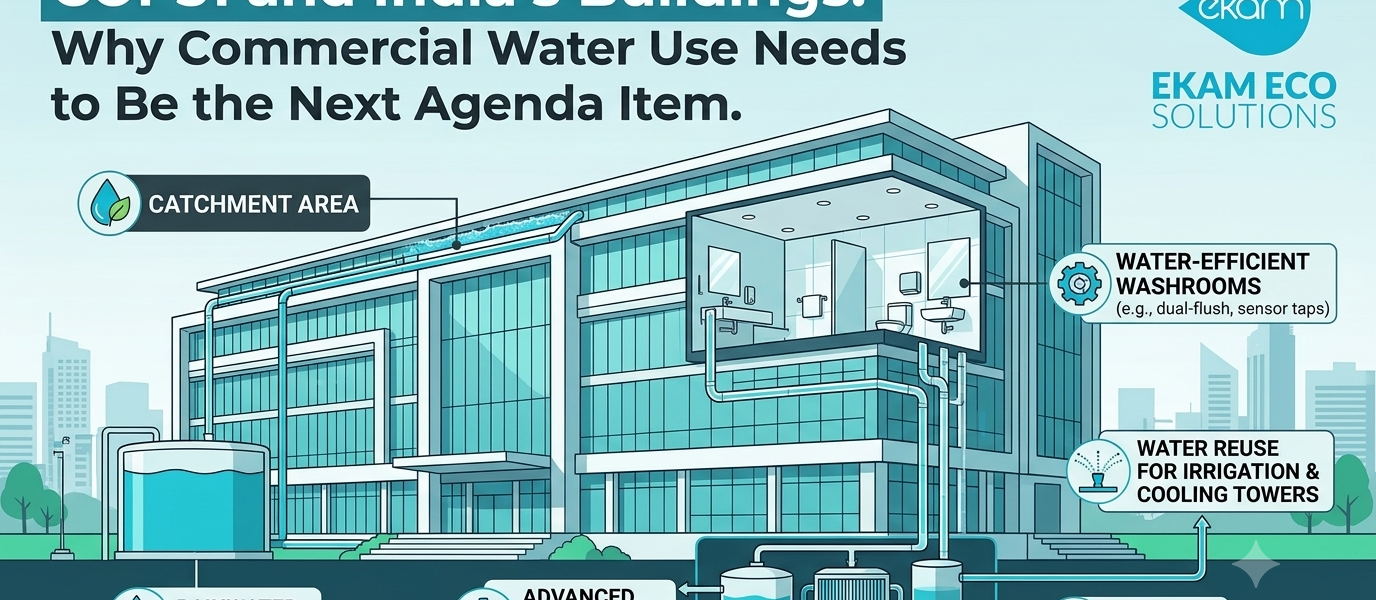
- Cooling towers and HVAC systems.
- Landscaping and gardening.
- Drinking water and other facility requirements.
Individually, these activities may appear routine. Collectively, they create a substantial operational water footprint.
The problem is not simply that buildings use water. It is that many organisations do not measure consumption at the level of individual activities. Without that information, it becomes difficult to identify avoidable usage, set realistic reduction targets or assess whether conservation measures are working.
Why this matters particularly in India?
India’s growing commercial infrastructure makes this issue increasingly relevant. According to the Bureau of Energy Efficiency, India is constructing approximately 300,000 square feet of commercial floor space every day. The agency also estimates that around 40% of the building stock that will exist over the next two decades is yet to be built.
This creates an important opportunity. Water efficiency should not be treated as an improvement that buildings consider only after construction. It should be incorporated into building design, procurement, facility planning and operational standards from the beginning.
The challenge is also relevant to existing infrastructure. Older commercial buildings may have conventional plumbing systems, ageing fixtures and limited water-monitoring arrangements. Even where organisations have introduced energy-saving measures, their water consumption may not receive the same level of scrutiny.
For a country where water availability varies considerably across regions and seasons, this gap deserves attention. Commercial water demand also interacts with municipal infrastructure. Water must be sourced, treated, transported and eventually managed as wastewater. Every stage requires infrastructure, energy and financial resources.
Reducing unnecessary consumption can therefore offer benefits beyond an individual building’s water bill.
The connection between water and climate action
Water conservation is sometimes treated as a separate environmental activity, disconnected from climate mitigation. In practice, the two are closely connected. Supplying water to a building requires pumping, treatment and distribution. Depending on the source and infrastructure, these activities consume electricity. Wastewater collection and treatment also require energy.
Inside buildings, water may be pumped to overhead tanks, circulated through systems and heated for particular uses. Inefficient consumption can increase the demand placed on these services. This means that using less water can also help reduce the energy associated with its supply and management.
There is another climate-related consideration: resilience. Heatwaves, irregular rainfall and periods of water scarcity can put pressure on urban water systems. Commercial buildings that depend entirely on uninterrupted external water supplies may face operational difficulties when availability becomes uncertain.
A water-efficient building is not automatically climate-resilient, but responsible water management can strengthen its ability to cope with supply disruptions.
Restrooms: A practical starting point for water efficiency
One area where commercial buildings can begin making measurable improvements is the restroom. Toilets and urinals are frequently used throughout the day in offices, hospitals, educational campuses, airports and shopping complexes. Their cumulative water demand can become significant, particularly in high-footfall facilities.
Conventional flushing urinals require water for every flush. In buildings with substantial daily footfall, repeated flushing creates a recurring demand that can be examined through a water audit.
Water-efficient fixtures, leak detection, appropriate flushing systems and regular maintenance are practical measures. Another option is waterless urinal technology. Waterless urinals are designed to operate without conventional flushing water. Depending on the system, they use specialised sealing mechanisms to prevent odours from escaping through the drainage outlet.
Correct installation, compatible cleaning practices and routine maintenance remain essential for hygiene and performance. The point is not that one technology will solve every building’s water challenge. Rather, facility managers should evaluate where conventional water use can be avoided without compromising hygiene, accessibility or user experience.
For organisations exploring this approach, companies such as Ekam Eco Solutions offer water-saving and sustainable hygiene solutions, including waterless urinal technology.
Why COP31 should encourage measurable building water targets?
COP31’s emphasis on resilient cities and the built environment provides an opportunity to broaden the discussion. Energy-efficiency targets are important, but buildings also need measurable water-performance indicators. Without them, sustainability assessments may overlook an important part of everyday resource consumption.
India could strengthen this approach through several practical steps.
- Make water audits a regular practice
Large commercial facilities should periodically assess water consumption across restrooms, kitchens, cooling systems, landscaping and other major uses. Sub-metering can help identify where demand is concentrated.
- Include water efficiency in building performance assessments
Building sustainability evaluations should consider both energy and water performance. A building that performs well on electricity consumption but wastes substantial quantities of water presents an incomplete picture of resource efficiency.
- Encourage water-efficient procurement.
Developers and facility managers can prioritise efficient fixtures, low-water technologies, leak detection systems and products that reduce unnecessary consumption when renovating or constructing buildings.
- Improve wastewater management and reuse
Where technically and economically appropriate, treated wastewater can be reused for suitable non-potable applications such as landscaping and flushing. Reuse systems must follow applicable treatment and quality requirements.
- Publish operational performance data.
Businesses should disclose meaningful water-consumption indicators alongside energy and emissions information. Transparent reporting can help investors, employees, customers and facility operators understand whether sustainability commitments are translating into measurable results.
Moving from climate commitments to everyday building operations
The significance of COP31 lies not only in the commitments discussed by governments but also in the implementation opportunities it creates for cities, businesses and institutions. India’s commercial buildings are an important part of that implementation landscape. They influence electricity demand, municipal water requirements, wastewater generation and the daily resource habits of millions of people.
The next phase of sustainable building development should therefore move beyond the idea that a green building is primarily an energy-efficient building. It should also be a building that understands its water footprint, avoids unnecessary consumption, manages wastewater responsibly and prepares for changing water availability.
COP31 has helped bring the built environment into the climate implementation conversation. The opportunity now is to ensure that commercial water use receives equally serious attention. After all, climate action is not measured only by the energy a building saves. It should also be measured by how responsibly that building uses the water on which its daily operations depend.