From ₹0 to ₹4 Lakh Saved: How We Cut Commercial Water Bills with One Fixture

When lowering operating expenses, companies look at electricity consumption, employee costs, procurement and equipment maintenance. Water bills, on the other hand, don’t always get the same level of scrutiny. There are busy office buildings and shopping centres, hospitals and factories. All have multiple people using their bathroom facilities every day.
Some people may remember to turn off the water in sinks and showers, but not many think about the water consumption of a conventional urinal. Each time somebody uses a conventional urinal, water is wasted. While one flush of a urinal may not use a significant amount of water, over the course of hundreds of uses a day by thousands of users, that amount quickly adds up.
What if that number could be reduced, while still allowing users the same level of service?
That’s where waterless urinal technology comes in. By getting rid of the need for frequent flushing, businesses are saving water and better using the facilities they already have.
The Small Fixture Behind a Surprisingly Large Water Bill
Continuous use of restroom facilities in commercial establishments from office buildings to airports, hotels and shopping complexes means water is continuously being wasted in urinals. Like flushing toilet bowls, each use of a urinal sends a volume of treated water into the drainage system. While that volume may be small in each use, the problem is in the repetition.
Taking a typical commercial building with:
- 10 conventional urinals
- 100 uses per urinal per day
- Water is being wasted!
- Each flush uses 2 liters of water.
- These urinals are estimated to be flushed 300 times a year.
Water consumption for these urinals in a year would be:
10 x 100 x 2 x 300 = 600,000 liters
Therefore, for just 10 urinal fixtures, 600,000 liters of water would be used in a year.
600,000 liters is equivalent to 6 lakh liters.
Customer numbers, volumes flushed, and time of day flushing occurs would affect actual consumption. Thus, this type of calculation demonstrates the amount of water used in a commercial building’s restrooms and justifies the need for greater water management control.
What If Urinals Did Not Need Flushing Water?
Waterless urinals challenge a design theory that has been in use for many years which states that for every use of a urinal, a flush of water is required. A waterless urinal is designed to capture and remove urine in a drain without the use of flushing water. To remove drain gases, the design uses a mechanical one-way valve which opens to allow liquid to pass through and then immediately closes to prevent the flow in the opposite direction.
Zerodor technology by Ekam Eco Solutions Pvt. Ltd. uses this type of mechanism. According to Zerodor, their system uses a one-way mechanical valve which remains closed until urine flows through it and opens to let the urine flow to the drain. The valve then immediately closes to prevent the flow of gases through the drain.
Once the valve closes, drain gases are stopped from flowing back through the drain. Hence water is not needed for flushing. It is important to note that using a waterless urinal does not mean there will be no maintenance or cleaning required. For optimal performance and hygiene of the restroom, regular cleaning and maintenance is required.
Comprehending the Savings in Rupees
Financial savings from waterless urinals are more than just the amount of water saved. Depending on their location, businesses must also account for the cost of water, sewage, and pumping, as well as other relevant expenses. According to the Guidelines for Green and Climate Resilient Healthcare Facilities by the Indian government, one waterless urinal can save between 56,800 and 170,000 litres of water a year.
Zerodor’s technology page also estimates potential annual savings of 150,000 litres per urinal. Let’s look at this example financially. Suppose there are 20 conventional urinals in a facility, each of which uses 150,000 litres of water for flushing in a year.
- Annual saving per urinal: 150,000 litres
- Total potential annual saving: 3,000,000 litres
- Savings in water in kilolitres: 3000 KL
Let’s assume the combined cost of supplying water and removing sewage is ₹133.33 per kilolitre.
3000 KL x ₹133.33 = ₹400,000
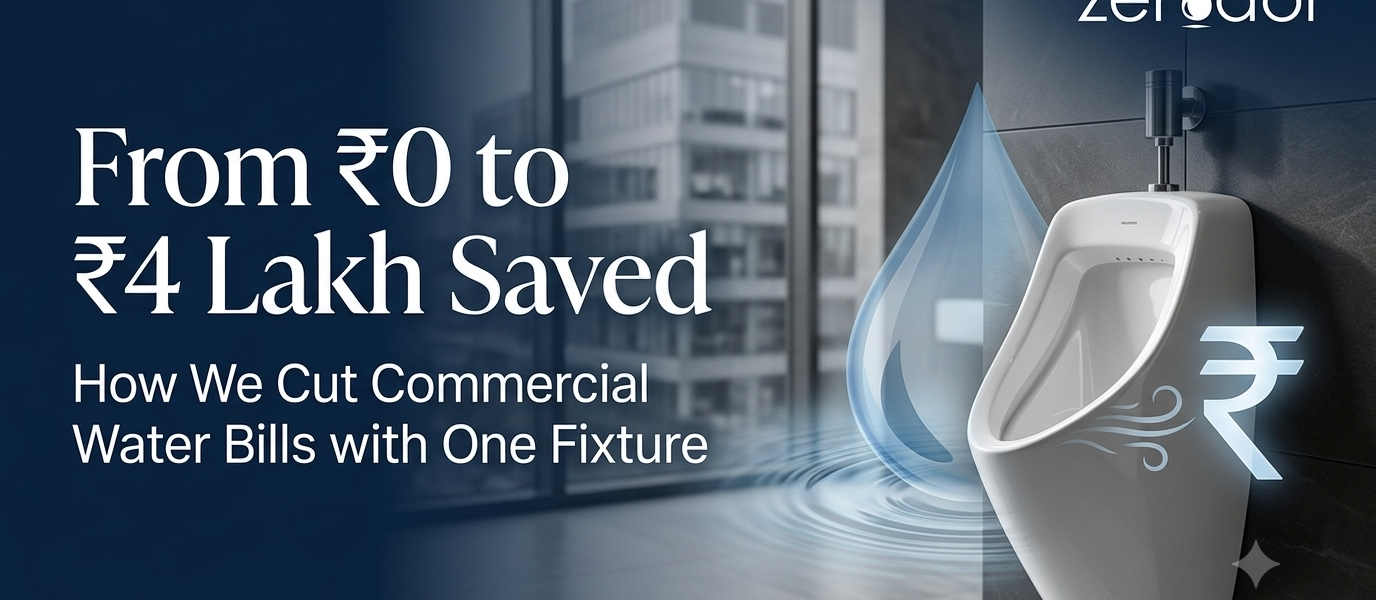
According to this example, the potential savings to the commercial facility may be around ₹4 lakhs per year. This illustrative financial example should not be construed to be a Zerodor customer case study or guarantee potential savings.
The actual costs and water-saving potential of a facility must be taken into account to arrive at more accurate financial benefits. Given the cost of water and consumption, conservation of water will always result in financial benefits to an organisation.
Why Retrofitting Can Be More Practical Than Replacing Fixtures?
One concern facility managers have when considering restroom upgrades is the cost and disruption associated with making these improvements. Traditionally, upgrading restrooms has meant purchasing new fixtures, modifying plumbing connections, scheduling and arranging the time for the work with the employees using the facilities, and possibly restricting restroom access.
Another method, known as retrofitting, gives the facility manager more options. An example of a waterless urinal conversion kit is Zerodor. As its name implies, a waterless urinal utilizes Zerodor technology to eliminate the need for water flushing. There are a number of practical advantages of this technology including:
- Not having to replace the current urinal pan.
- Less disruption to the facility infrastructure.
- Eliminating the need for a water flushing function reduces water and energy usage.
- There are no consumable chemical cartridges to be replaced.
- Routine maintenance and inspection of the waterless urinal are still required.
Some of these water saving features are relatively easy to incorporate into management plans for facilities with multiple buildings.
Financial Impact Goes Beyond Water Savings
Eliminating the need to flush urinals reduces the overall volume of water discharged to the sewage system. For facilities with on-site sewage treatment plants (STPs), this can help them better manage their water usage.
Lower pumping requirements
Water supplied to commercial buildings is often pumped and distributed throughout the building. Decreasing water demand in a building may lessen the electric load associated with pumping.
Fewer consumable replacements
Some waterless urinal technologies require the use of chemical or sealant cartridges which are disposed of and replaced on a regular basis. Zerodor’s mechanical valve approach eliminates the need for such consumables.
Better sustainability reporting
Measuring and reporting water usage can help companies align with environmental, social and governance (ESG) goals. Reductions in freshwater usage provide organizations with useful information to assess and report on their sustainability performance.
These benefits should not be automatically combined with additional financial benefits.
How Businesses Can Calculate Their Actual Return on Investment?
Prior to the installation of any water saving fixtures, facility managers should first establish a baseline. While perform a cost benefit analysis, facility managers should first assess how many conventional flush urinals there are on site. The second step would be to evaluate the volume of water used in each flush. Third would be to estimate the average daily use.
The last two steps would be to determine applicable sewerage charges and evaluate the costs associated with the new water saving fixtures.
The basic equation is:
Annual water savings = Flush volume x Daily uses x Operating days x Number of urinals
Where ‘Operating days’ is the total number of days the urinals would be in use in a year.
The estimate of annual financial savings would be:
Annual financial savings = Water saved in KL x Applicable marginal cost per KL
To determine payback period:
Payback period = Initial installation investment ÷ Annual net savings
Net savings should include all relevant operating costs and not include expenses reflected in water tariffs.
This enables businesses to discern between potential savings and real savings.
Water Conservation in Commercial Settings
Not all commercial sustainability initiatives require substantial capital investments and large-scale infrastructure changes. It can be as simple as modifying commonly used facilities. Water conservation, for example, can begin with evaluation and modification of fixtures that have been in use for many years.
One such opportunity is the use of waterless urinals. Businesses should assess high use commercial restrooms and identify conventional water conservation opportunities. Determine if there are retrofittable options to replace these fixtures.
The focus should not be on simply changing existing fixtures for new ones. It should be on achieving a significant reduction in water use to the extent that it would not negatively impact the use, comfort and cleanliness of the restroom.
For companies contemplating the use of waterless urinals, Zerodor provides information and mechanical diagrams on how to retrofit a traditional urinal to a waterless urinal. The general idea here is that commercial water conservation becomes more feasible when businesses identify where water is being used unnecessarily, and then eliminate that water use.
Conclusion
Looking only at the water consumption side of the equation, one could argue that, from a business case perspective, a more effective place to target water conservation measures would be to eliminate water consumption from urinals. Traditionally, a commercial building’s infrastructure would include many urinals, each of which would be repeatedly flushed with potable water.
Technology that eliminates the need for water to be flushed in a urinal would significantly reduce a facility’s water consumption and costs. The example provided for ₹ 4 lakhs shows the potential impact if similar water-saving fixtures were installed throughout a facility. It is likely that a significant reduction in water consumption would yield proportionate cost savings, though this is not guaranteed.
Ultimately, it is more beneficial for facility managers to determine their consumption levels and associated costs to make better decisions on water infrastructure. Implementing sustainability measures for a commercial building need not be an extensive, costly renovation. Often times, simply rethinking one fixture can bring significant improvements.
Frequently Asked Questions (FAQs)
1. How can commercial buildings reduce water bills through waterless urinals?
Commercial buildings can reduce flushing-water consumption by replacing conventional flushing arrangements with suitable waterless urinal systems. The actual financial savings depend on daily usage, existing flush volume, local water tariffs, and installation costs.
2. How much water can one waterless urinal save annually?
Water savings can vary considerably depending on footfall and the existing flushing system. Government guidelines indicate potential annual savings of approximately 56,800–1,70,000 litres per urinal.
3. Do waterless urinals require special plumbing?
Not necessarily. Some systems are designed to retrofit compatible existing urinals. For example, Zerodor uses a mechanical valve-based retrofit mechanism, potentially avoiding the need to replace the entire urinal fixture.
4. Are waterless urinals hygienic for commercial buildings?
Yes, when appropriately designed, installed, cleaned, and maintained. Waterless urinals eliminate routine flushing but still require regular surface cleaning, drain inspection, and suitable restroom hygiene practices.
5. Can waterless urinals help reduce sewage treatment costs?
They can reduce the additional wastewater volume created by conventional urinal flushing. This may help reduce hydraulic loading on an STP. Actual operating-cost reductions depend on the treatment system and its operating conditions.
6. Is switching to waterless urinals financially worthwhile?
It can be, particularly in high-footfall facilities with significant existing flushing-water consumption. Businesses should compare installation expenses against projected annual water, sewage, and maintenance savings before making a decision.
7. What makes Zerodor different from conventional flushing systems?
Zerodor uses a mechanical one-way valve mechanism to allow urine to enter the drainage system while helping prevent drain gases from returning through the urinal. Its retrofit approach eliminates routine flushing and does not rely on chemical sealant cartridges.